
The Sopranos: Cut to Black Mystery Solved! 🎬
The Sopranos did tony soprano die, the sopranos cut to black, the sopranos ending clues, the sopranos ending explained, the sopranos final scene, the sopranos finale breakdown, tony soprano death scene, who killed tony soprano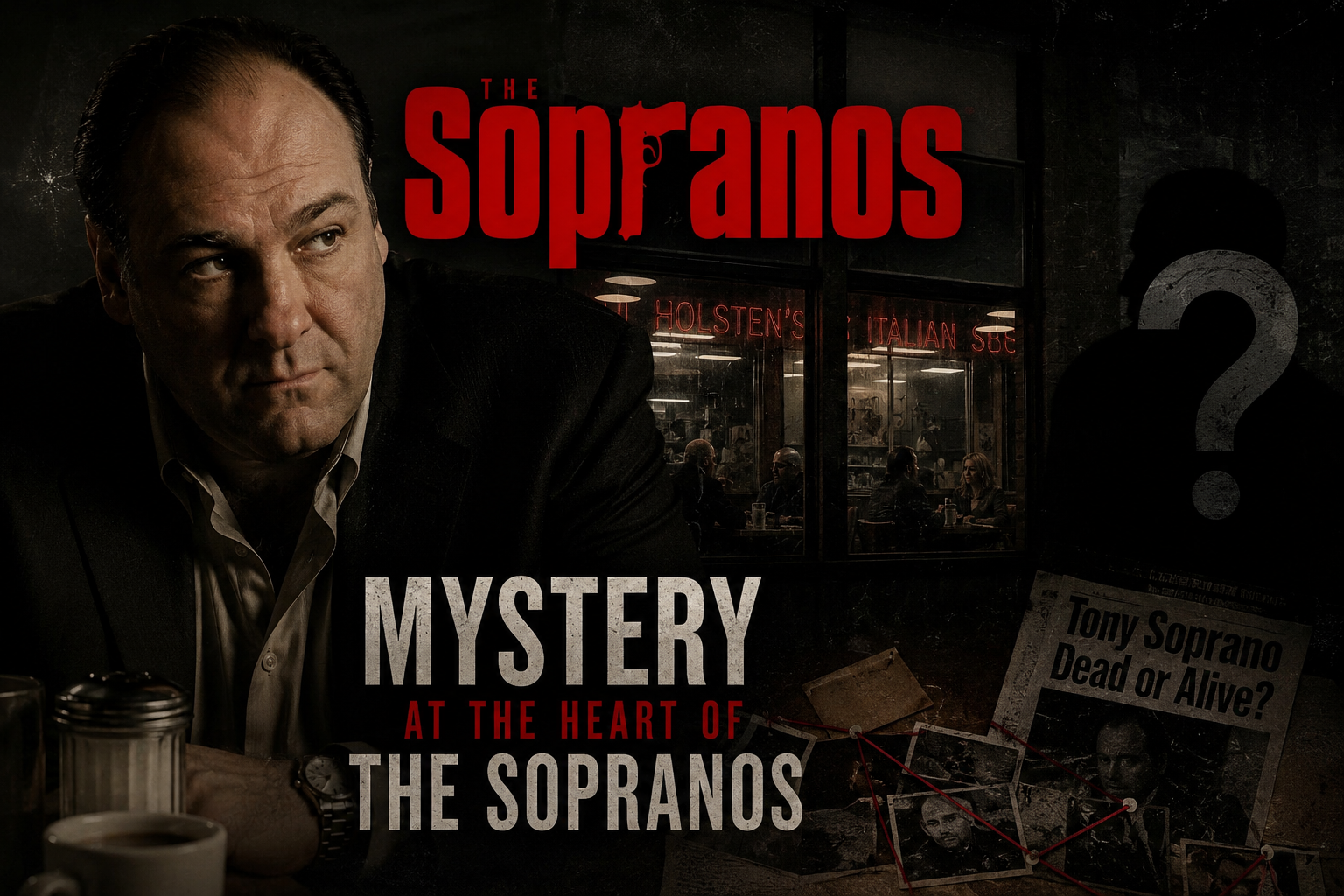
Don’t Stop Believin’: The Sacred Mystery at the Heart of The Sopranos
Few finales in the history of American television have generated as much fascination, controversy, and scholarly scrutiny as the closing moments of The Sopranos. Indeed, nearly two decades after its original broadcast, audiences remain captivated by that final sequence inside Holsten’s diner. Ultimately, this deceptively ordinary scene was transformed into one of the most unsettling and enigmatic endings ever committed to screen.
There sits Tony Soprano: husband, father, mob boss, and increasingly haunted soul. Meanwhile, around him unfolds an unmistakably American tableau. For instance, families share meals while elderly couples linger over coffee. At the same time, Journey’s “Don’t Stop Believin’” hums from the jukebox as onion rings arrive at the table. Outside, however, Meadow struggles to parallel park before finally rushing toward the restaurant’s entrance.
Yet, beneath the comforting veneer of suburban normalcy lurks an atmosphere of almost unbearable dread.
David Chase meticulously constructs a symphony of anxiety from the mundane. Every glance becomes significant. Every stranger appears potentially threatening. A man in a Members Only jacket moves suspiciously through the diner. Two young men enter the restaurant and briefly attract Tony’s attention. The bell above the front door rings repeatedly as customers come and go. Each chime feels increasingly ominous.
Then Meadow finally opens the door.
Tony looks up.
The screen cuts to black.
Nothing.
No gunshot. No explanation. No resolution.
Only silence.
As a result, the sequence culminated in one of the most audacious narrative gambles in television history. In fact, millions of viewers initially assumed their cable service had malfunctioned, while others immediately launched into debates that continue to this day. Was Tony assassinated? Did the abrupt blackout signify his death? Alternatively, was Chase illustrating something even more unsettling—specifically, that Tony would spend the remainder of his life trapped within a perpetual state of vigilance, forever awaiting the violence he had inflicted upon others?
Crucially, the brilliance of the ending lies precisely in its refusal to answer those questions. Therefore, the ambiguity is not a puzzle to be solved but rather a mystery to be contemplated. Indeed, that distinction—between puzzle and mystery—reveals something essential about The Sopranos itself.
Ultimately, beneath its reputation as the definitive mob drama, and similarly beneath its dark comedy, psychological realism, and cultural satire, The Sopranos is fundamentally a spiritual drama. More specifically, it stands as one of the most profound explorations of Catholic mystery ever produced within American popular culture.
Consequently, throughout its six seasons, the series repeatedly confronts questions that exist far beyond the reach of human certainty, such as redemption, damnation, divine judgment, free will, mortality, grace, and the possibility of salvation. Furthermore, its characters inhabit a universe governed not merely by criminal codes or social structures, but instead by metaphysical forces that remain largely unseen yet unmistakably present.
In contrast to many crime dramas that employ religious imagery merely as aesthetic decoration, The Sopranos treats the supernatural with startling seriousness. For example, ghosts appear, prophetic dreams unfold, and visions emerge without explanation. Meanwhile, omens linger heavily in the background as the dead refuse to remain silent.
The world of The Sopranos is permeated by the numinous.
Again and again, David Chase invites viewers to glimpse a reality operating just beyond ordinary perception. Christopher Moltisanti’s terrifying vision following his near-death experience suggests the existence of an afterlife. Paulie Gualtieri’s encounters with psychics and apparitions imply that the dead maintain an active presence among the living. Tony himself repeatedly finds his dreams becoming gateways into realms that feel less psychological than metaphysical.
These moments resist easy interpretation because they are not designed to be interpreted away.
They are manifestations of mystery.
And mystery, in both the Catholic tradition and The Sopranos, is not ignorance waiting to be resolved. It is the recognition that certain truths transcend rational explanation.
This helps explain why seemingly minor unresolved questions within the series continue to fascinate audiences. Consider the legendary disappearance of the Russian in “Pine Barrens,” perhaps the show’s most famously unanswered subplot. After being shot and apparently mortally wounded, the Russian vanishes into the frozen wilderness without a trace.
Viewers have spent decades attempting to determine what happened.
Yet perhaps the more interesting question is why the uncertainty bothers us so much.
The forest in folklore has always been a realm where ordinary rules collapse. It is the domain of spirits, monsters, transformations, and disappearances. People enter the woods and emerge changed—or fail to emerge at all. By allowing the Russian to disappear into this mythic landscape, The Sopranos invokes a far older tradition than modern crime fiction. It reaches back into the primordial territory of myth itself.
The unknown remains unknown.
The mystery remains intact.
That commitment to ambiguity extends beyond the supernatural and into the very structure of the series. Dreams, hallucinations, symbols, and fragmented memories constantly blur the boundaries between reality and imagination. Drawing inspiration from figures as diverse as Alfred Hitchcock, Federico Fellini, Carl Jung, Sigmund Freud, and especially David Lynch, Chase crafts a narrative universe where meaning often exists in suggestion rather than certainty.
Like Lynch’s Twin Peaks, The Sopranos understands that mystery is not an obstacle to storytelling but one of storytelling’s most powerful tools.
The unexplained possesses a unique emotional potency.
It lingers.
It haunts.
It refuses to leave us alone.
Perhaps this is why The Sopranos feels even more relevant today than when it first aired. We live in an era increasingly hostile to ambiguity. Contemporary culture demands explanations, definitive answers, and exhaustive interpretations. Every work of art is dissected through endless explainer videos, theory threads, and algorithmic content designed to eliminate uncertainty.
Mystery has become something to conquer rather than experience.
Yet The Sopranos insists on the opposite.
It asks viewers to sit with uncertainty.
To acknowledge that not every question has an answer.
To accept that some truths can only be approached indirectly.
The famous cut to black remains so powerful not because it conceals information, but because it confronts us with a reality we spend most of our lives trying to avoid: the limits of our own understanding.
In the end, Tony Soprano’s fate matters less than the existential condition the scene embodies.
Life unfolds without guarantees.
Meaning remains elusive.
Death arrives without warning.
And the deepest mysteries remain mysteries.
The screen goes black.
The questions endure.
And somewhere, faintly, Journey keeps playing.